 Demos
Demos  Colors
  Docs
Docs  Support





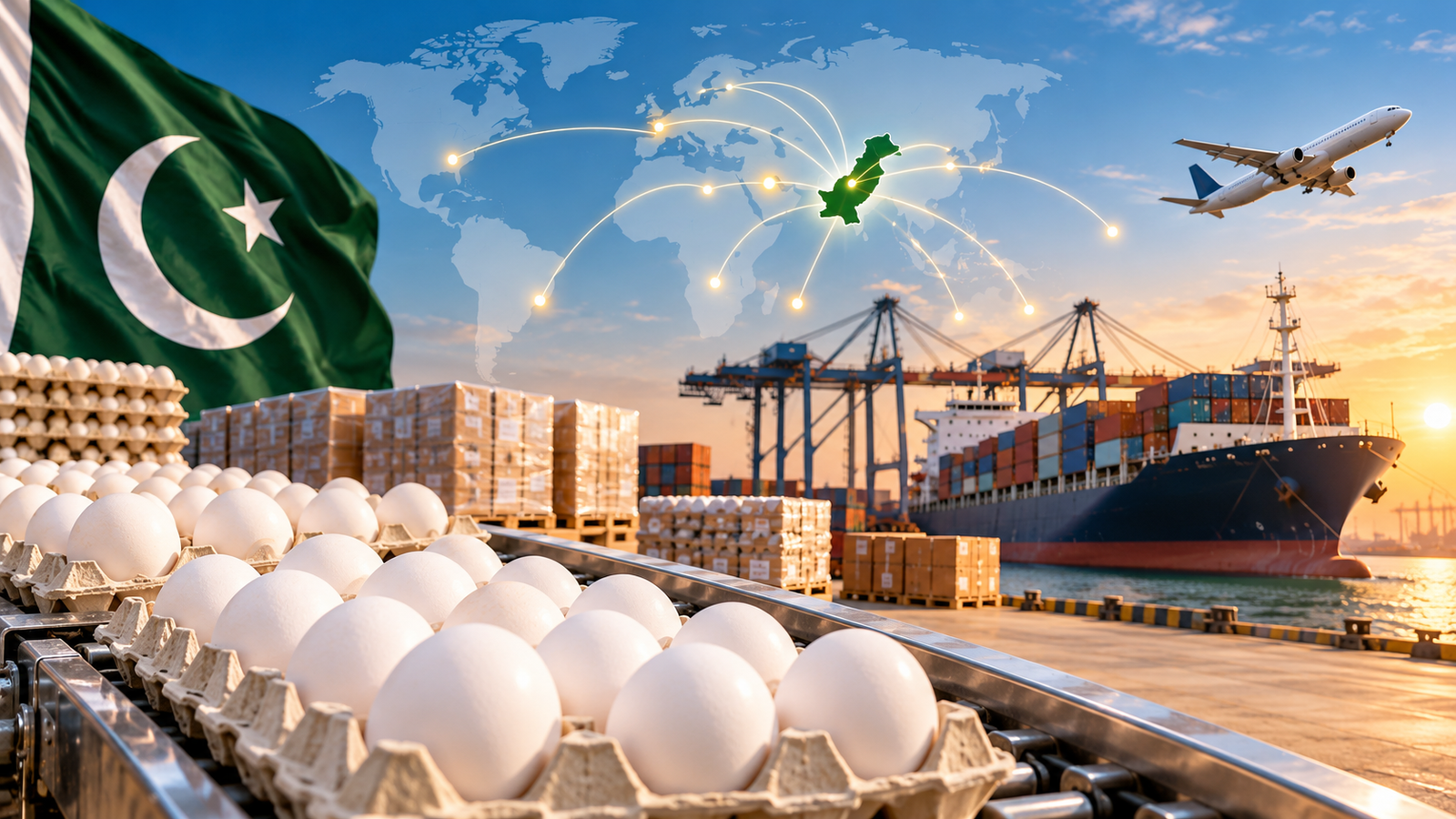
The future of egg exports from Pakistan will depend on the country’s ability to supply quality eggs, meet international food safety rules, and deliver orders on time. Pakistan has already built a presence in overseas markets, and its recent export figures show clear signs of growth.
According to World Bank WITS trade data, Pakistan exported approximately US$31.98 million worth of in-shell eggs in 2025, compared with US$22.71 million in 2024. This represents an increase of about 40.8% in export value.
The next stage of growth will depend on how exporters improve grading, farm management, storage, transport, and relationships with international buyers. New markets and processed egg products may also create opportunities, provided suppliers can meet the required standards.
This article examines Pakistan’s current export position, the changes that could shape the industry by 2030, and the steps needed to build a stronger position in global egg trade.
- The Current Position of Pakistan's Egg Export Industry
- Which Markets Could Shape the Future of Egg Exports?
- What Will Drive the Future of Egg Exports From Pakistan?
- What Challenges Could Slow Pakistan's Egg Export Growth?
- How Could Egg Processing Support Pakistan's Export Future?
- How Can Pakistan Build Stronger International Buyer Confidence?
- What Is the Future of Egg Exports From Pakistan by 2030?
- Frequently Asked Questions About the Future of Egg Exports
- What Is the Future of Egg Exports From Pakistan?
- Which Countries Import Eggs From Pakistan?
- What Are the Biggest Challenges for Pakistani Egg Exporters?
- Can Pakistan Increase Its Processed Egg Exports?
- How Will Technology Affect Pakistan's Egg Export Industry?
- Can Pakistan Become a Larger Egg Exporter by 2030?
- How Roomi Poultry Limited Is Supporting the Future of Egg Exports From Pakistan
The Current Position of Pakistan’s Egg Export Industry
Pakistan has a large poultry sector that produces eggs for domestic consumers and international markets. Its egg export business has developed over time, with shipments reaching buyers in the Middle East and other regions.
The global egg industry is also large. According to the Food and Agriculture Organization (FAO), world egg production reached approximately 100 million tonnes in 2024, with hen eggs making up 94% of the total.
Most eggs are consumed within the countries where they are produced. International trade therefore requires producers to manage additional needs such as export packing, product inspection, transport conditions, and import documents.
For Pakistan, the opportunity is to strengthen these systems while building on its existing export relationships.
Pakistan’s Egg Export Performance in 2024 and 2025
The latest complete annual figures used in this article show growth in both the value and volume of Pakistan’s in-shell egg exports.
| Export Indicator | 2024 | 2025 |
| Export value | US$22.71 million | US$31.98 million |
| Export volume | 5.32 million kg | 7.41 million kg |
| Growth in export value | — | 40.8% |
| Growth in export volume | — | 39.3% |
Source: World Bank WITS, Pakistan exports, HS code 040700.
These figures cover fresh, preserved, and cooked birds’ eggs in shell. They should not be presented as figures for fresh table eggs alone.
The increase is an encouraging sign for Pakistan’s egg industry. However, one year of growth does not guarantee that exports will continue rising at the same rate.
Future performance will depend on market demand, production costs, import restrictions, and the ability of exporters to maintain reliable supply.
For more background on Pakistan’s position in international trade, read Why Pakistan Is Emerging as a Global Egg Export Hub.
Which Markets Could Shape the Future of Egg Exports?
Pakistan’s existing export destinations provide a useful starting point for understanding where future opportunities may develop.
In 2025, the United Arab Emirates was the largest reported destination for Pakistan’s in-shell egg exports, followed by Saudi Arabia and the United States.
Pakistan’s Major Egg Export Destinations in 2025
| Export Destination | Export Value (US$) | Export Volume |
| United Arab Emirates | 21.19 million | 4.98 million kg |
| Saudi Arabia | 5.21 million | 835,793 kg |
| United States | 3.28 million | 798,665 kg |
| Afghanistan | 662,970 | 74,182 kg |
| Bahrain | 516,560 | 205,940 kg |
Source: World Bank WITS, 2025. Figures are rounded.
The UAE accounted for approximately 66% of Pakistan’s reported export value in this category during 2025.
This shows the importance of the UAE market, but it also highlights a risk. If a large share of exports depends on one destination, changes in demand or import rules can affect the wider industry.
Opportunities in the Gulf Region
The UAE, Saudi Arabia, and Bahrain are already part of Pakistan’s egg export network. Existing trade activity can help suppliers understand buyer needs and build stronger business relationships.
Exporters may find opportunities to increase repeat orders by offering consistent egg sizes, suitable packaging, clear documents, and dependable shipment schedules.
However, each country has its own import rules. Suppliers must confirm current animal health conditions, food safety requirements, and product approvals before accepting orders.
Opportunities Beyond Existing Markets
Pakistan’s 2025 trade records also show exports to countries and territories outside the Gulf region, including Afghanistan, Somalia, and Hong Kong.
These trade links may provide opportunities to study new buyer groups and different distribution needs.
However, the presence of a country in past export records does not mean every Pakistani supplier or egg product is currently approved for entry.
Future market expansion will require careful research, official permissions, and an understanding of each destination’s product standards.
What Will Drive the Future of Egg Exports From Pakistan?
The future of egg exports will be shaped by improvements across the production and supply process. International buyers need eggs that meet agreed standards and arrive in suitable condition.
Higher production alone cannot meet these expectations. Exporters must also improve the systems used to grade, handle, pack, store, and transport eggs.
1. Modern Egg Grading and Consistent Quality
Egg grading helps suppliers sort eggs according to characteristics such as weight, shell condition, and other agreed requirements.
International buyers may need specific sizes and grades for supermarkets, wholesale markets, or food service businesses. Differences between shipments can create problems for these customers.
Modern grading equipment can help improve consistency and identify eggs that do not meet the required standards.
Roomi Poultry’s layer farming information provides a practical example of technology already being used in Pakistan. The use of Dutch egg processing and grading systems, along with automated equipment in its layer farming operations.
This shows that advanced grading technology is already part of some Pakistani poultry businesses. Wider adoption of suitable systems could help more exporters improve product consistency.
2. Better Food Safety and Farm Management
Food safety is important because eggs pass through several stages before reaching international buyers.
Farm hygiene, flock health, egg collection, equipment cleaning, and handling procedures can all affect the safety and quality of the final product.
The FAO and WHO Codex Code of Hygienic Practice for Eggs and Egg Products provides international guidance for managing food safety risks.
Exporters should maintain clear records of their procedures and check that their operations meet the rules of their target markets.
Food safety systems can help buyers evaluate a supplier, but they do not automatically provide permission to export to every country.
3. Improved Storage and Cold Chain Systems
Eggs need suitable storage and transport conditions to protect their quality during international shipments.
A cold chain is a system used to maintain controlled temperatures during storage and transport. The exact temperature requirements for eggs depend on the product and the rules of the destination market.
Poor handling, unsuitable storage, and long delays can increase the risk of product damage or rejection.
For Pakistan, investment in storage facilities, transport equipment, and shipment monitoring could help suppliers serve longer delivery routes.
Exporters should also plan for delays at ports and borders, since unexpected waiting times can affect the condition of a shipment.
4. Stronger Packaging and Traceability
Egg packaging must protect products during loading, transport, and unloading.
Suitable trays, cartons, and shipping cases can help reduce breakage. Clear labels also make it easier for importers to check quantities and identify products.
Traceability means being able to identify where a product came from and which batch it belongs to.
For an egg exporter, useful records may include farm details, collection dates, grading results, packing information, and shipment numbers.
These records can help suppliers and buyers investigate quality concerns and manage product recalls when required.
5. Reliable Supply for Regular International Orders
Many international buyers need eggs every week or month. Their businesses depend on suppliers that can meet agreed delivery schedules.
An exporter may have enough eggs for one shipment but struggle to maintain the same quantity throughout the year.
Production changes, domestic demand, grading results, and existing customer orders can all affect export availability.
Suppliers that plan their production and packing capacity carefully may be better placed to support long-term contracts.
This is particularly important for importers supplying supermarkets, distributors, and food service businesses.
What Challenges Could Slow Pakistan’s Egg Export Growth?
Pakistan’s egg export industry has opportunities, but it also faces risks that can affect production, costs, and market access.
Some challenges can be managed by individual businesses, while others require support from government agencies and industry groups.
| Industry Challenge | Possible Impact | Area for Improvement |
| Animal disease outbreaks | Lower production and possible import restrictions | Farm health monitoring and biosecurity |
| Rising production costs | Higher export prices | Better production planning and feed efficiency |
| Uneven egg quality | Buyer complaints and rejected shipments | Consistent grading and quality checks |
| Transport delays | Higher costs and product losses | Better shipment planning and storage |
| Changing import rules | Delayed or restricted market access | Regular checks with official authorities |
| Dependence on a few markets | Greater risk when demand changes | More buyer and market development |
Animal Health and Market Access
Animal disease control remains important for international poultry trade.
Disease outbreaks can affect production and may lead importing countries to introduce temporary restrictions.
Exporters must maintain suitable farm health procedures and stay informed about changes in official import requirements.
A previous shipment to a country does not guarantee that future shipments will be permitted under the same conditions.
Production Costs and Export Prices
Egg production costs are affected by feed, energy, labour, farm operations, and other business expenses.
International buyers also consider freight, insurance, inspection charges, customs costs, and local delivery expenses.
A competitive export price must therefore be supported by efficient production and careful shipment planning.
Suppliers that control costs while maintaining product quality may be better positioned to retain international customers.
How Could Egg Processing Support Pakistan’s Export Future?
Processed egg products could create another area of growth for Pakistan’s poultry industry.
Fresh table eggs serve retail and wholesale customers, while processed egg products may be used by food manufacturers, bakeries, and other commercial businesses.
These products require suitable processing facilities, food safety controls, and approvals for the intended market.
Pakistan Already Exports Some Processed Egg Products
World Bank WITS records show that Pakistan exported products in separate processed egg categories during 2025.
| Product Category | HS Code | 2025 Export Value |
| Birds’ eggs not in shell, excluding dried products | 040899 | US$2.51 million |
| Egg yolks, excluding dried products | 040819 | US$2.41 million |
Sources: WITS HS 040899 and WITS HS 040819.
These figures confirm that Pakistan already participates in some processed egg export categories.
However, they do not prove that every type of processed egg product has strong demand or that every exporter can enter these markets.
Companies considering processing investments should first study customer requirements, expected order volumes, production costs, and food safety rules.
What Will Help the Processing Industry Grow?
Processed egg production requires suitable equipment and reliable supplies of eggs that meet the required standards.
Companies must also manage hygiene, storage, product testing, and traceability.
The opportunity will depend on whether Pakistani producers can meet the needs of commercial buyers at competitive prices.
If these conditions improve, processed egg products could help the industry reach customers beyond the traditional shell egg market.
How Can Pakistan Build Stronger International Buyer Confidence?
International buyers usually assess several factors before selecting a long-term egg supplier.
They need clear product specifications, suitable documentation, and confidence that the supplier can meet future orders.
Clear Product and Quality Specifications
Exporters should provide written information about egg sizes, grades, shell colour, packaging, and available quantities.
Buyers should also understand how the supplier checks quality before shipment.
Clear specifications reduce confusion and make it easier to compare different suppliers.
Better Communication and Export Documents
Export orders may require health certificates, packing lists, invoices, certificates of origin, and other documents.
The exact requirements depend on the destination country and shipment conditions.
Exporters should agree with buyers on who will prepare each document and when it will be available.
Timely communication about shipment schedules and possible delays can also support stronger business relationships.
More Consistent Delivery Performance
A buyer’s confidence grows when suppliers meet agreed standards across repeated orders.
This requires coordination between farms, grading facilities, packing teams, and transport providers.
Companies that manage these activities carefully may have a better chance of securing repeat business.
For importers who want to understand supplier selection in more detail, the related guide How to Choose a Reliable Egg Supplier for Your Import Business explains the main checks to complete before placing an order.
What Is the Future of Egg Exports From Pakistan by 2030?
Pakistan’s egg exports could develop in several ways by 2030, but the available evidence does not support an exact forecast of future export value or volume.
The 2025 trade figures show recent growth. They do not establish how quickly the industry will grow over the next four years.
The following table outlines possible developments based on current industry needs.
| Area | Possible Development by 2030 | What Will Be Needed |
| Export destinations | Stronger relationships in existing markets and possible entry into new ones | Market research and official import approvals |
| Egg grading | More consistent export quality | Suitable grading equipment and trained teams |
| Storage and transport | Better handling of longer shipments | Improved facilities and transport planning |
| Processed egg products | More business with food manufacturers | Processing investment and confirmed buyer demand |
| International contracts | More repeat orders | Reliable supply and delivery performance |
| Product traceability | Better batch records and quality checks | Recordkeeping systems and staff training |
These are possible developments, not guaranteed outcomes.
A Strong Growth Scenario
Pakistan could build on its recent export growth if more producers improve their grading systems, food safety procedures, and supply capacity.
Better transport arrangements and access to additional markets could also help exporters serve a wider range of buyers.
In this scenario, growth would be supported by more reliable supply and stronger international relationships.
A Slower Growth Scenario
Export growth could slow if production costs rise, animal disease restrictions affect market access, or suppliers struggle to maintain consistent quality.
Dependence on a small number of destinations could also create problems if demand changes.
This makes it important for the industry to improve its operations while developing more than one source of international demand.
What Should the Industry Measure?
Export value alone cannot show whether the industry is becoming stronger.
Businesses and industry groups should also pay attention to shipment quality, delivery performance, repeat orders, rejected products, and the number of active export markets.
These measures can provide a clearer picture of progress over time.
Frequently Asked Questions About the Future of Egg Exports
What Is the Future of Egg Exports From Pakistan?
The future of egg exports from Pakistan is supported by recent growth in international trade. Export value increased by approximately 40.8% in 2025 compared with 2024. Further growth will depend on product quality, food safety, reliable supply, and access to international markets.
Which Countries Import Eggs From Pakistan?
According to 2025 World Bank WITS data, Pakistan’s major reported destinations for in-shell eggs included the United Arab Emirates, Saudi Arabia, the United States, Afghanistan, and Bahrain. Exporters must check current import rules before arranging shipments.
What Are the Biggest Challenges for Pakistani Egg Exporters?
Important challenges include animal disease risks, production costs, transport conditions, changing import rules, and the need for consistent egg quality. These issues can affect both export prices and delivery performance.
Can Pakistan Increase Its Processed Egg Exports?
Pakistan already exports products in some processed egg categories. Future growth may be possible if businesses invest in suitable facilities, meet food safety requirements, and secure demand from international food manufacturers.
How Will Technology Affect Pakistan’s Egg Export Industry?
Modern grading, farm equipment, and recordkeeping systems can help producers improve consistency and manage quality. Their value depends on proper use, regular maintenance, and trained staff.
Can Pakistan Become a Larger Egg Exporter by 2030?
Pakistan has opportunities to expand its egg exports, but there is no verified forecast in the sources reviewed that guarantees a particular export value by 2030. Progress will depend on market access, production efficiency, food safety, and reliable delivery.
How Roomi Poultry Limited Is Supporting the Future of Egg Exports From Pakistan
Pakistan’s egg export industry has made progress, with recent trade figures showing higher export value and volume. Its next stage of development will depend on modern production systems, better food safety, consistent grading, and stronger relationships with international buyers.
Roomi Poultry Limited has played a pioneering role in Pakistan’s table egg export industry. The company identifies itself as Pakistan’s first table egg exporter, with its export history dating back to 2013.
Roomi Poultry operates across feed production, layer farming, and egg processing. This connected business model allows the company to manage important parts of the egg production process.
Its layer farming operations use automated equipment, while its Dutch egg grading and processing systems support consistent handling and product quality. These are practical examples of the technology that can help strengthen Pakistan’s export industry.
Readers can explore the operations in more detail through How Roomi Poultry Produces International Quality Eggs.
In 2022, Roomi Poultry received the Golden Egg Award at the International Egg Conference in Rotterdam, becoming the first Pakistani company to receive this recognition. The award marked an important achievement for the company and Pakistan’s poultry industry.
Roomi Poultry’s production systems, export experience, and international recognition provide a strong foundation for its role in Pakistan’s developing egg export sector.
As the industry moves toward new markets and higher buyer expectations, continued investment in quality and reliable supply will remain important.
Are you Interested in sourcing eggs from Pakistan?
Contact Roomi Poultry Limited to discuss available egg grades, order quantities, packaging requirements, and export arrangements for your market.
Related Posts
How to Choose a Reliable Egg Supplier for Your Import Business
An egg supplier can affect product quality, shipping costs, and your ability to meet customer…
Why Pakistan Is Emerging as a Global Egg Export Hub
Egg Export Pakistan is gaining attention as local producers expand into international markets and strengthen…

How Roomi Poultry Produces International Quality Eggs
Producing an egg is simple. Producing millions of eggs with consistent quality, safety, hygiene, and…

