 Demos
Demos  Colors
  Docs
Docs  Support





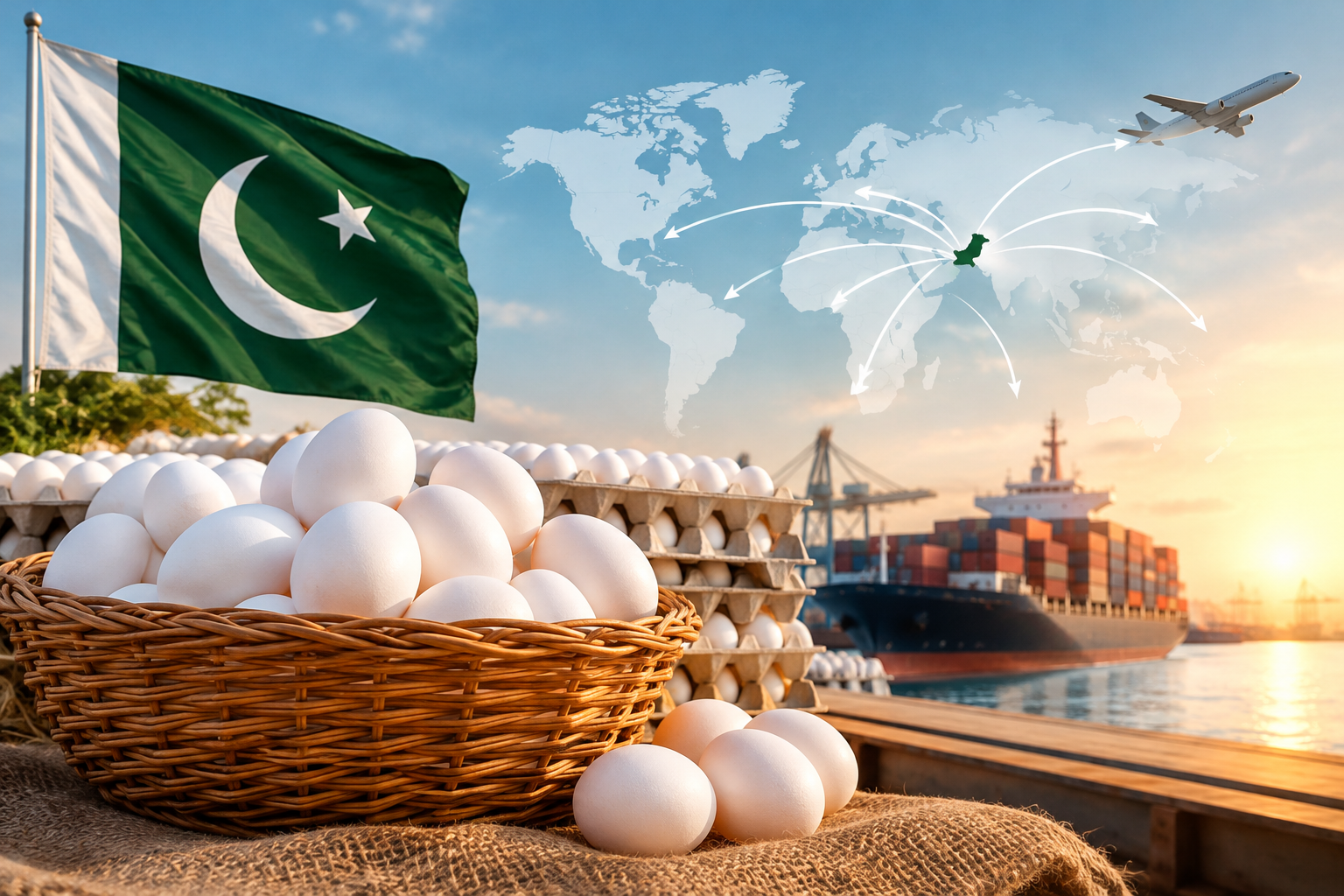
Egg Export Pakistan is gaining attention as local producers expand into international markets and strengthen their production, quality, handling, and supply systems.
The country already has an established export base, with Pakistani table eggs reaching markets in the Middle East, Central Asia, Africa, and other destinations.
In 2024, Pakistan exported more than 5.3 million kilograms of in-shell eggs worth about US$22.7 million, according to World Bank WITS trade data. The United Arab Emirates and Saudi Arabia were the two largest destinations by export value.
The opportunity is larger than the current export numbers suggest. Global egg production reached about 100 million tonnes in 2024, with hen eggs making up 94% of total production, according to the Food and Agriculture Organization.
At the same time, the global egg market is expected to grow by about 2% per year through 2035, with the total market projected to become 22% larger.
Nearly 90% of new demand is expected to come from emerging markets, including countries across Asia, Africa, and Latin America.
For Pakistan, this creates a clear opportunity. The country has a large poultry sector, an existing egg production base, access to nearby markets, and companies that have already developed experience in international egg trade.
The next stage will depend on how well Pakistan can improve consistency, food safety, cold chain handling, grading, traceability, processing, and long-term relationships with international buyers.
- Pakistan Already Has an Egg Export Base
- Global Egg Demand Creates a Larger Opportunity
- Quality and Food Safety Will Shape Pakistan's Export Future
- Technology Is Changing the Egg Export Business
- Pakistan Can Move Beyond Table Egg Exports
- Roomi Poultry Limited and Pakistan's Egg Export Opportunity
- FAQs About Egg Export Pakistan
- Conclusion
Pakistan Already Has an Egg Export Base
Pakistan is not starting from zero. Its egg industry already has experience in international trade, and recent trade data shows that Pakistani eggs are reaching several foreign markets.
In 2024, Pakistan exported 5.32 million kilograms of in-shell eggs with a total value of about US$22.71 million. The UAE accounted for about US$9.87 million of that trade, followed by Saudi Arabia at about US$8.28 million. Afghanistan, Uzbekistan, and Hong Kong were also recorded as destinations.
Pakistan also exported processed egg products in 2024. Exports of birds’ eggs not in shell, excluding dried eggs, were worth about US$1.63 million, while egg yolks excluding dried yolks were worth about US$1.91 million. These products reached markets such as the UAE, Saudi Arabia, Bahrain, Kuwait, Oman, and Egypt.
These figures matter because they show that Pakistan’s opportunity is not limited to fresh table eggs. The country can develop a wider egg value chain that includes shell eggs, liquid egg products, dried products, egg yolks, and other processed formats.
The Gulf Is Already an Important Market
The Gulf region is particularly important for Pakistan’s egg export business. The UAE and Saudi Arabia were the largest destinations for Pakistan’s in-shell egg exports by value in 2024. Their geographic position also gives Pakistani suppliers a practical route into wider regional food markets.
For exporters, proximity alone is not enough. International buyers need dependable supply, clear product specifications, suitable packing, proper documentation, and reliable delivery. This means Pakistan’s future export growth will depend as much on supply chain performance as it does on production volume.
Global Egg Demand Creates a Larger Opportunity
The global egg industry is already large and continues to grow. FAO data shows that world egg production reached 100 million tonnes in 2024. The scale of this market gives major producing countries a strong base for domestic supply, food processing, and international trade.
The longer-term outlook is also positive. The World Egg Organisation and Rabobank expect the global egg market to grow by about 2% annually through 2035, resulting in a market that is around 22% larger by the end of the period. The report also estimates that nearly 90% of new demand will come from emerging markets.
This is important for Pakistan because many of the expected growth markets are located in regions that are geographically closer to Pakistan than major Western markets. Pakistan can therefore compete in selected markets where supply reliability, product quality, freight costs, and delivery time support a strong business case.
International Egg Trade Is Still Relatively Small
There is another reason Pakistan has room to grow. Only around 2% of global egg production is currently traded internationally, according to the World Egg Organisation and Rabobank.
Most eggs are consumed close to where they are produced because eggs are perishable and require careful handling.
This makes export readiness a major advantage. A producer that can manage grading, packing, temperature control, food safety, documentation, and shipping has a better chance of serving buyers beyond its domestic market.
Pakistan’s future success will therefore depend on creating systems that make international trade easier and more reliable, rather than simply producing more eggs.
Quality and Food Safety Will Shape Pakistan’s Export Future
Egg exports require more than a good product. International buyers need confidence that the same quality can be delivered across repeated shipments. This requires control at several stages of the production and supply chain.
Farm conditions matter because bird health, nutrition, water quality, biosecurity, and flock management can affect production and egg quality. After collection, eggs need careful handling, inspection, grading, packing, storage, and transportation.
Food safety systems also become more important as exporters enter markets with strict requirements. A strong export operation needs documented processes, trained teams, controlled handling, and clear records that support traceability.
Consistency Matters More Than One Good Shipment
A buyer may accept one strong shipment, but a long-term export relationship requires repeat performance. Egg size, packing, product specifications, delivery schedules, and quality standards need to remain consistent from one order to the next.
This is one area where Pakistan’s egg industry can strengthen its position. Better grading systems, automated handling, quality checks, cold chain infrastructure, and farm controls can help exporters deliver more predictable results.
For buyers, consistency reduces risk. For exporters, it supports repeat orders and stronger relationships.
Technology Is Changing the Egg Export Business
Technology is becoming an important part of modern egg production and trade. The World Egg Organisation reported in September 2026 that data, automation, artificial intelligence, and connected technologies are increasingly shaping egg value chains. These tools can support better farm management, production control, traceability, and decision-making.
Modern egg export businesses can use technology across several stages. Automated collection can reduce unnecessary handling. Grading systems can sort eggs according to size and quality. Digital records can improve traceability. Temperature monitoring can help protect products during storage and transport.
Cold Chain and Handling Are Critical
Eggs can travel long distances before reaching the final buyer. Proper handling and temperature control can therefore play an important role in protecting quality and shelf life during the export journey.
For Pakistan, stronger cold chain systems can support access to more distant markets. This becomes especially important as exporters move beyond nearby regional destinations and explore markets where transit times are longer.
Pakistan Can Move Beyond Table Egg Exports
The next opportunity for Pakistan may come from value-added egg products. International demand is not limited to shell eggs. Food manufacturers use egg products in bakery, food processing, sauces, ready-to-eat foods, and other applications.
Pakistan’s existing trade data already shows exports of eggs not in shell and egg yolks. This suggests that the country has a base from which a wider egg processing industry can develop.
Value-added processing can also help exporters reach buyers who need specific ingredients rather than whole eggs. Liquid egg products, dried egg products, egg whites, and egg yolks can serve different parts of the food industry.
Processing Can Create New Export Markets
The development of local processing facilities could give Pakistan more options in international trade. Processed products can have different storage, transport, and customer requirements compared with fresh table eggs.
This creates a path from traditional egg exports toward a broader egg business. It can also increase the value generated from the country’s poultry production base.
This shift would require investment in processing technology, food safety systems, skilled teams, certification, market research, and reliable raw material supply.
What Pakistan Needs to Become a Stronger Egg Export Hub
Pakistan has the production base and early export experience, but long-term growth will depend on several practical factors.
- Reliable Production
Export buyers need supply that can support their business plans. Producers therefore need strong farm management, bird health programs, nutrition systems, and production planning.
- Strong Quality Systems
Quality needs to be checked throughout the value chain. Farm controls, egg handling, grading, packing, food safety, and traceability all contribute to the final export product.
- Better Logistics
An export shipment involves much more than moving eggs from a farm to a port. Storage, temperature control, transport planning, documentation, customs procedures, and shipment timing all affect the buyer experience.
- Market Knowledge
Each international market has its own buyer expectations and import requirements. Exporters need to understand product specifications, packing, documentation, food safety rules, and commercial terms before entering a new market.
- Long-Term Buyer Relationships
Export growth becomes more stable when buyers return for repeat orders. Reliable service, clear communication, consistent product quality, and timely delivery can help exporters develop long-term relationships.
Roomi Poultry Limited and Pakistan’s Egg Export Opportunity
Roomi Poultry Limited is one example of how Pakistan’s egg industry is developing an export-focused business model.
Its egg export journey began in 2012, followed by Pakistan’s first table egg export in 2013. Its current business includes egg production, feed milling, and egg processing, giving it control across important parts of the poultry value chain.
Roomi Poultry eggs reach international markets, and the company has received the Golden Egg Award from the World Egg Organisation. The award was presented in 2022 and made Roomi Poultry the first Pakistani company to receive the recognition.
The company’s export story reflects a wider opportunity for Pakistan. Global buyers need suppliers that can manage production, quality, grading, packing, food safety, and export requirements as one connected process.
Roomi Poultry’s integrated model is designed around these areas, and its stated focus includes supplying eggs to both local and international markets.
The company is also looking toward higher-value egg products. Roomi Poultry, a flagship of Iqbal Group of Companies, has announced a proposed partnership with Ovodan Foods A/S of Denmark for pasteurized liquid egg processing, which could support the next stage of its egg value chain and create opportunities in value-added egg exports.
FAQs About Egg Export Pakistan
Is Pakistan an egg-exporting country?
Yes. Pakistan exports table eggs and processed egg products to international markets. In 2024, Pakistan exported about 5.32 million kilograms of in-shell eggs worth approximately US$22.71 million.
Which countries import eggs from Pakistan?
Pakistan’s 2024 in-shell egg exports included the UAE, Saudi Arabia, Afghanistan, Uzbekistan, Hong Kong, Qatar, and Kazakhstan. The UAE and Saudi Arabia were the largest destinations by export value.
Why is Pakistan suitable for egg exports?
Pakistan has an established poultry sector, a large domestic market, existing export experience, and geographic access to major markets in the Middle East and Asia. Continued investment in quality, food safety, logistics, and processing can strengthen its export position.
What makes an egg suitable for international export?
Export suitability depends on the requirements of the destination market and buyer. Factors can include egg quality, size, grading, food safety, packing, shelf life, traceability, documentation, and proper handling during transportation.
Can Pakistan export processed egg products?
Yes. Pakistan already exports products such as eggs not in shell and egg yolks. In 2024, these categories generated additional export value beyond in-shell table eggs.
What is the future of Pakistan’s egg export industry?
The outlook depends on continued investment in production, quality systems, export logistics, market access, technology, and value-added processing. Global egg demand is expected to grow through 2035, creating opportunities for efficient producers and exporters.
Conclusion
Pakistan has the foundations needed to become a stronger player in the global egg trade. Its existing export markets, poultry production base, geographic position, and growing focus on quality and processing provide a platform for further growth.
The opportunity will depend on consistent supply, strong food safety systems, reliable logistics, market knowledge, and the ability to meet buyer requirements across international markets.
Roomi Poultry Limited represents this direction through its export-focused egg business, integrated poultry operations, international market experience, and plans for value-added egg processing.
Its journey from Pakistan’s first table egg export in 2013 to wider international markets shows how a local poultry business can develop into an export-oriented enterprise.
For international buyers looking for table eggs from Pakistan, Roomi Poultry Limited provides an established point of contact for discussing product specifications, order volumes, packing, delivery, and destination-market requirements.
Buyers can contact the export team at info@iqbalgroup.com or +92 323 0504725.
Related Posts

How Roomi Poultry Produces International Quality Eggs
Producing an egg is simple. Producing millions of eggs with consistent quality, safety, hygiene, and…

